Aerin Project Founder Jon Glaser Speaks Live at LABx Chicago 2026
After the loss of his daughter Aerin in 2024, Jon discovered a powerful legacy she left behind. Before departing for college, Aerin had written a series of handwritten letters for her best friend to open during life's most challenging moments. Moved by her extraordinary thoughtfulness, Jon transformed her idea into a school program that encourages empathy, meaningful connection, and the revival of the lost art of handwritten letters.
How a Handwritten Letter Can Matter Deeply
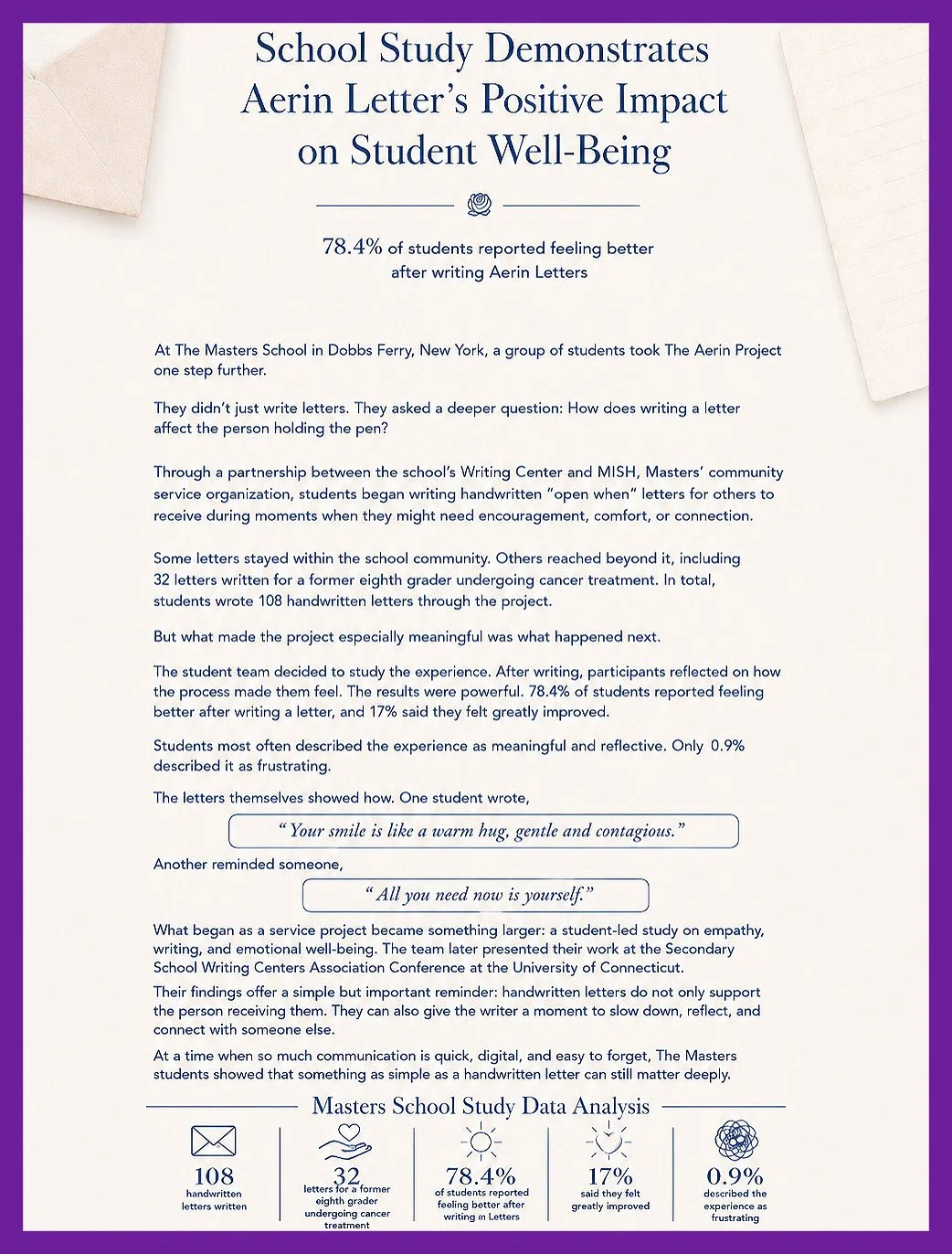
“At The Masters School in Dobbs Ferry, New York, what began as a service project became something larger : a student-led study on empathy, writing, and emotional well-being.”
The Aerin Project Arrives at the USC School of Dramatic Arts
Los Angeles, CA • June 2026
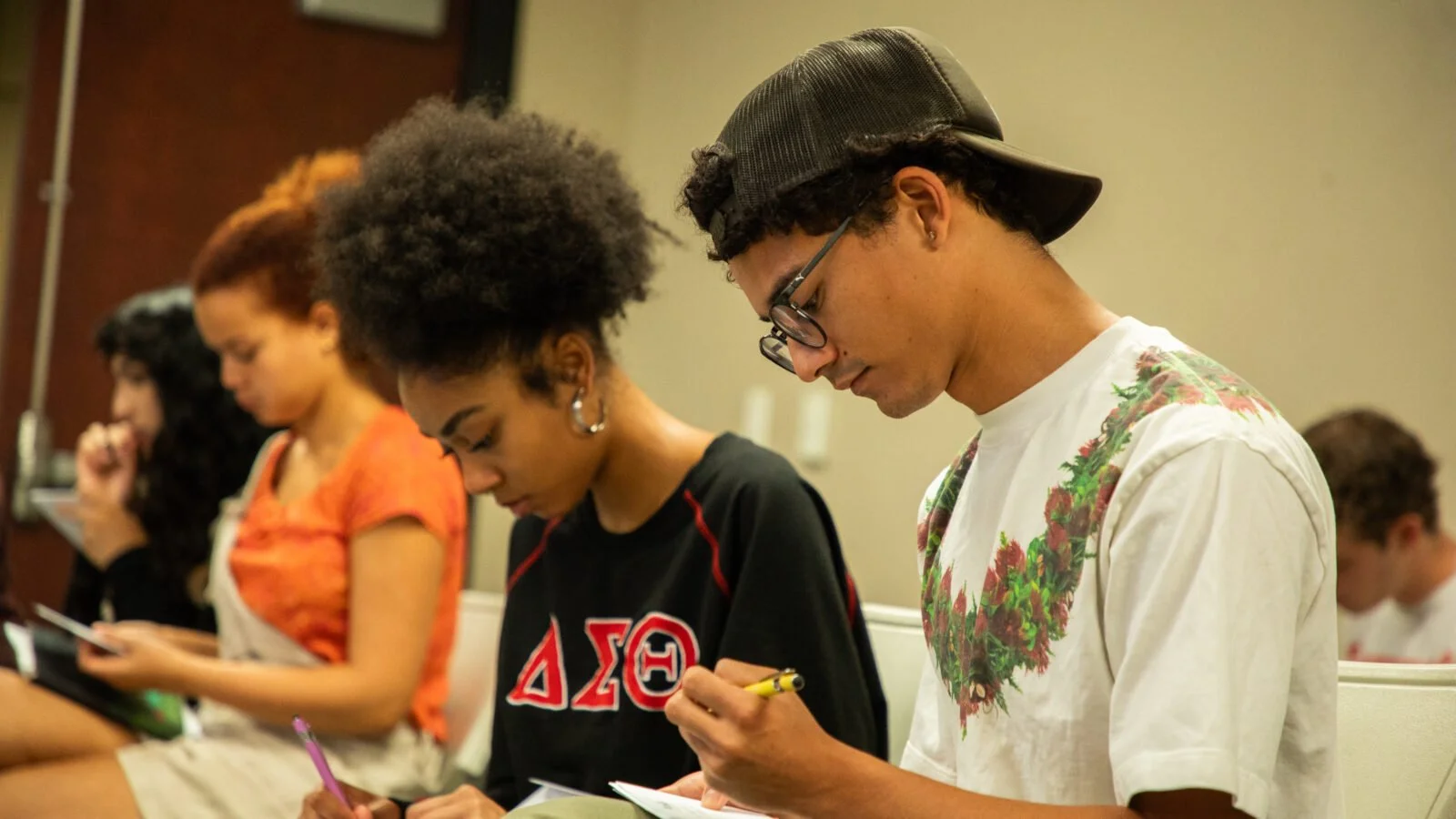
Aerin Rose Glaser believed in the power of thoughtful words arriving at exactly the right moment. She showed that when she gave her best friend a collection of handwritten letters before leaving for college, each labeled for a specific moment of need. In late April, her family brought that same spirit to the USC School of Dramatic Arts, inviting the community to carry it forward.
The visit marked the launch of The Aerin Project at the school, with programming that reached students, faculty, and staff across the SDA community. Class visits were followed by a gathering at the USC School of Dramatic Arts’ Sparks Center for Community and Culture, where faculty and staff came together to learn more about the initiative. Each event featured a TED-style talk by Aerin’s father, Jon, who spoke about his daughter and the project inspired by her legacy.
A Student’s Legacy Becomes a National Movement
Aerin, a Los Angeles native, was joyful, creative, and deeply connected to the people in her life. She came to the school to pursue a BFA in theatrical design with an emphasis in costume design, a natural fit for her creativity and artistic vision. She had a lifelong love of sewing, fashion design, beadwork, and jewelry making, along with an extraordinary gift for building lasting friendships. Her time at SDA, a place she loved deeply, would be all too brief. She passed away from cancer during her first year at USC.
Before leaving for college, Aerin created a gift that reflected the thoughtfulness she brought to every relationship.
The letters Aerin gave her friend, labeled with messages such as “Open when you need a confidence boost,” “Open when you feel homesick,” and “Open when you need a laugh,” were her way of remaining present for someone she loved across distance and uncertainty. After Aerin’s death, the letters took on an even deeper meaning.
Jon and his family founded The Aerin Project to expand that vision. Now active in more than 40 schools nationwide, the initiative invites students, colleagues, and communities to write letters to one another simply to encourage, uplift, and remind each other they are seen. No grades. No expectations. Just one person showing up for another. To date, over 7,000 letters have been written.
Bringing The Aerin Project to the USC School of Dramatic Arts
At the USC School of Dramatic Arts, where storytelling depends on empathy and human connection, The Aerin Project feels like a natural extension. Students are trained to look closely at another person’s experience, and this project invites them to do it through a letter. For Ann Closs-Farley, assistant professor of costume design and costume shop director, the initiative reflects the qualities that made Aerin such a memorable member of the SDA community.
“Aerin was deeply passionate about creating and had a remarkable natural talent, but what truly set her apart was her magnetic authenticity,” Closs-Farley said. “She lived with sincerity, mindfulness, and genuine kindness that made people feel seen and valued. Her warmth and humanity left a lasting impact on our community. We’re so grateful to Aerin’s parents for creating The Aerin Project. It carries forward her legacy by inviting our community to practice the same kindness, compassion and creativity that defined Aerin’s life.”
Carrying Aerin’s Legacy Forward
Aerin believed meaningful words could reach people at just the right moment. Jon closed his talk with a favorite story: when Aerin was around ten, she made herself a gift, wrapped it carefully, and left it on the kitchen table addressed “to Aerin, from Aerin,” waiting for her future self to come home and open it. She understood, Jon said, that even Aerin needed a little Aerin in her life. The Aerin Project is now part of the SDA community, and someone here will open exactly what they need, exactly when they need it.
Open when you need a friend: Whitefish students write letters to spread encouragement
Whitefish, MT • March 2026
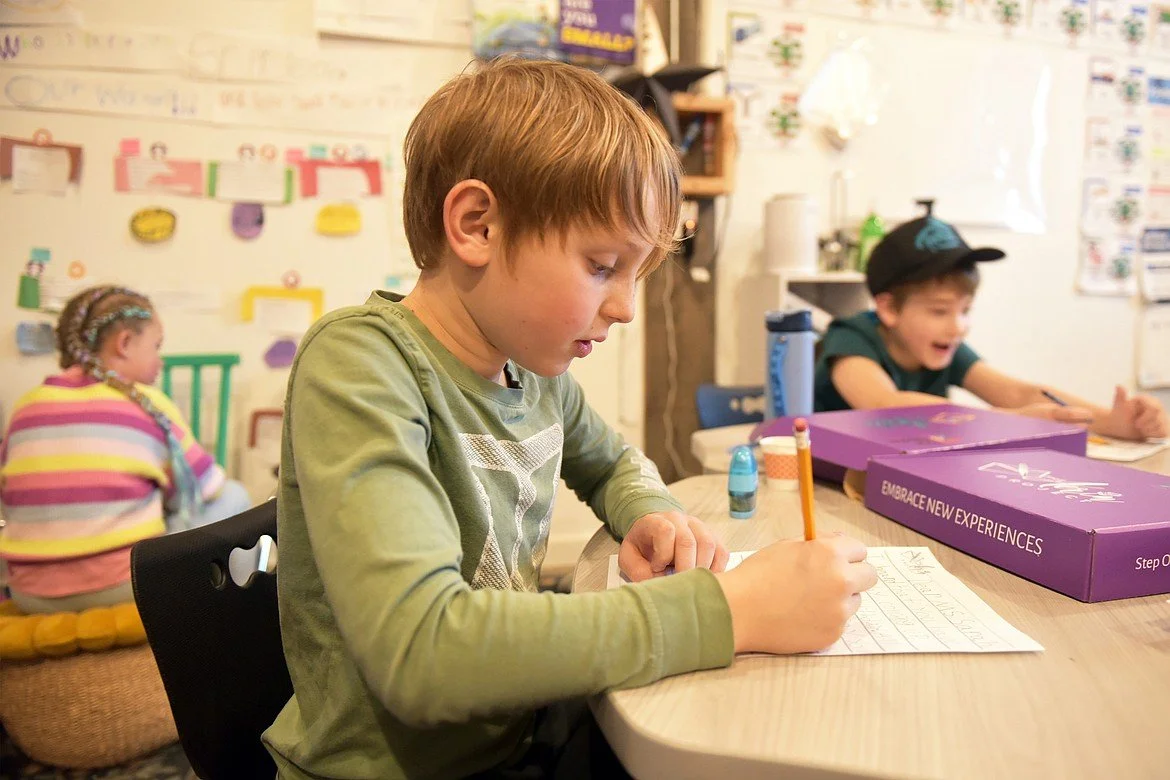
On a drizzly March afternoon in Whitefish, a class of second and third graders clustered around tables, equipped with pencils and lined paper.
Their assignment – to write a letter – was simple, but its lesson complex.
“It’s Mrs. CC’s birthday today,” Skola teacher Kyler Lefler said to the class. “What can we write to her to make her feel good? What are some things we can say that make her feel special?”
Well accustomed to the twice weekly task, the students got to work on the four-sentence assignment.
The Skola, as well as the Whitefish Christian Academy, are among several schools across the nation to participate in The Aerin Project, a curriculum that teaches students to support others through letters.
Open when you need a friend, open when you feel misunderstood, and open when you’re scared, are just a few of the infinite number of prompts to guide students in writing positive messages to their peers.
“I like that it’s personal,” said Skola student Luke Waiton. “You can say what you like about them and say all your joys about them.”
The young student expressed an understanding of the intimacy of letters.
“It’s not like telling a lot of people,” he said.
Waiton said his favorite letter he wrote over the year was a letter to a fourth grader named Aspen.
“When she got it, she was really excited,” he said.
Waiton’s classmate, Harrison Hughes, said his favorite was a letter to a preschooler named Mason.
“He’s doing a project about the Winter Olympics,” Hughes said. “I told him that I think he’d win a gold medal.”
Lefler said that she had students start by writing letters to classmates and teachers, before extending their reach to friends far and wide, and even writing letters to businesses around town that the students enjoy.
“We talked about the process of the Postal Service, how people touch our mail to get it to where it’s going, and then we thought about the gratitude behind that,” she said. “We encourage them to stick with their creativity and imagination.”
Head of School Brooke Ober said that the Aerin Project has been a component of teaching how brains work. The concept exposes the students to topics that could be potentially uncomfortable, she said. And it teaches that through it all, there are people like Aerin.
“Aerin was a person who came into this world able to truly shine her light on all these beautiful things in other people,” Ober said. “And we can extend that as a class — and they just love it. They look forward to it all week.”
Aerin Rose Glaser, who was born and raised in Los Angeles, California, was diagnosed with a rare cancer at the age of 13.
“She was an extraordinary human being,” said her father, Jon Glaser. “She was so kind and just had a way of making people happy.”
After graduating high school, Aerin wrote a series of letters to her best friend, Tilly. Each came with a prompt such as open when you need a friend, and open when you need a pep talk.
Aerin went to Tilly’s house to deliver the letters the night before Tilly left for college.
Aerin died shortly after, in February 2024 at the age of 18. She lived a full life, despite battling through many treatments in her teenage years.
“And so, it was actually my son’s idea,” Jon said. “He was like, why don’t you go to their high school and ask them if the seniors could write letters to their friends, just like Aerin did for Tilly.”
The letter writing endeavor at the high school was a success.
Jon then went over to the elementary school where Aerin attended and pitched the idea. Staff and students were again enthusiastic about partaking in letter writing.
From there, the Aerin Project was born. Jon decided to create a letter-writing curriculum to help spread the project to other schools, providing structure for teachers and stationary boxes for students.
No matter the age or class, the project’s objective is to inspire empathy, kindness and gratitude, and to establish a space for an intimate but dwindling form of connection.
The Glaser family has frequented Whitefish for many years, and friends were able to help connect Jon to The Skola School and Whitefish Christian Academy to share the curriculum.
The Aerin Project is now being taught in 25 schools across the nation, from L.A. to Whitefish, from kindergarten to university classes. Glaser estimates over 3,000 letters have been written, and he hopes to reach more schools.
“It’s been gratifying, because it spreads kindness and honors my daughter,” he said.
The impact of the Aerin Project may even be backed by science. Kimberly Parrow, a mental health professional, adjunct assistant professor at the University of Montana, and affiliate of the Phyllis J. Washington Center for the Advancement of Positive Education, is leading a research study titled, “The effects of high school students receiving encouragement from peers on academic performance and wellbeing.”
The study is looking at the effect of Aerin Project letters on 16 to 18-year-old students at Sentinel High School in Missoula over the 2025-26 school year.
Meanwhile at the Whitefish Christian Academy, Head of School Rachel Erickson has seen true evidence of spreading hope throughout the school year.
Jessica Sliman’s fourth-grade class is participating. Once the class had written letters, they were recognized in front of the whole school, to show an example of how students can instill hope in each other, Erickson said.
“It works not only on letter writing skills, but also as a way to communicate God’s love to people who may need encouragement,” Erickson said. “It’s been a beautiful opportunity for our students to look outside of themselves, to write something that will help someone have a better day, or to realize that they are seen, that they are thought about, and they are prayed for.”
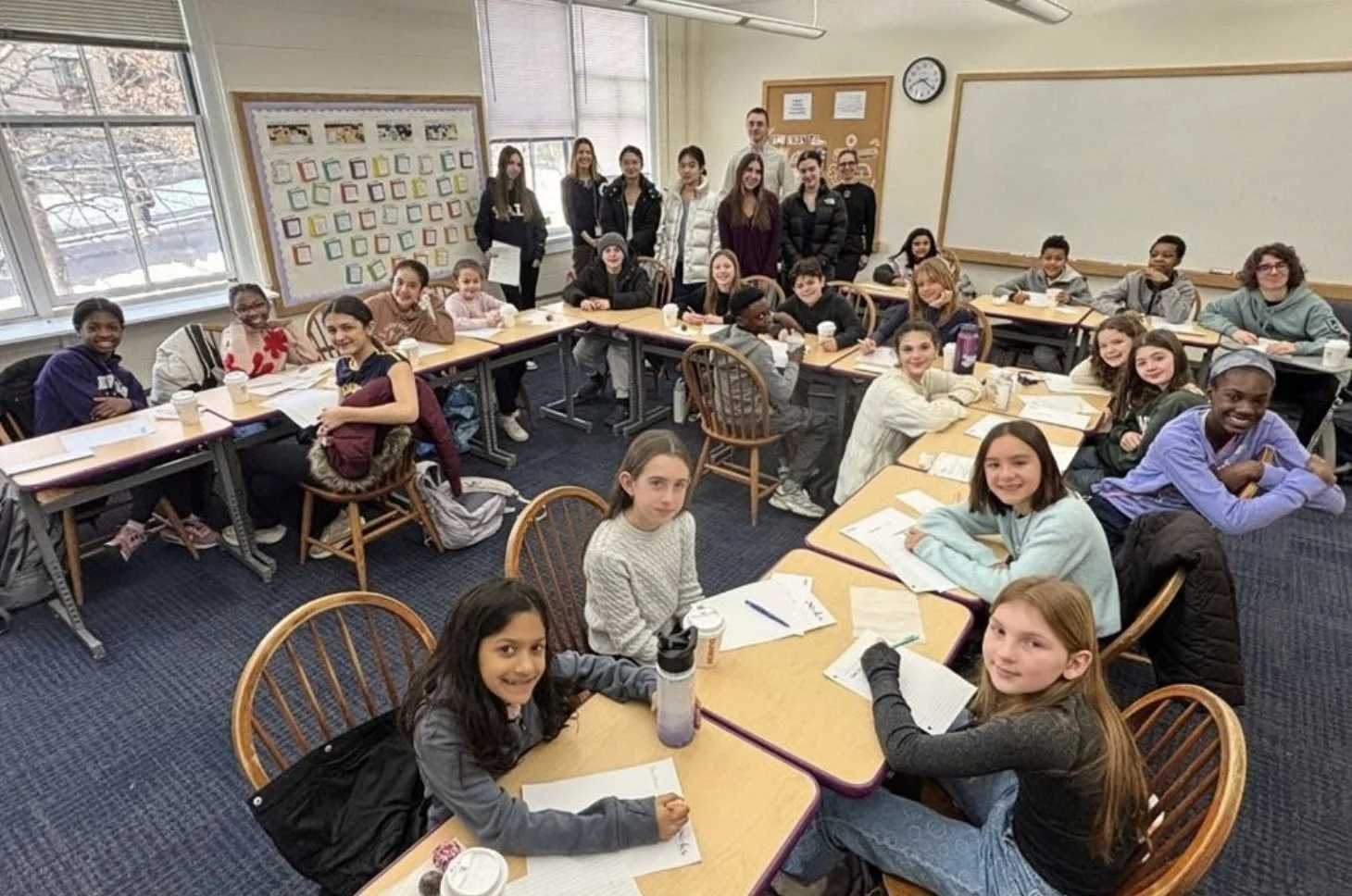
The Masters School:
Writing Project Promotes Being a Power for Good
Dobbs Ferry, MY • February 2026
Since last year, Julia Panos ’27 and Emily Kasoff ’27 have partnered to bring service, writing and connection to the Masters community.
Leaders in MISH (Masters Interested in Sharing and Helping) and tutors in the Writing Center, the two explored several initiatives before selecting The Aerin Project, a national letter-writing initiative now active in more than 20 schools.
The project was created in memory of Aerin Glaser, a Los Angeles teenager who died in 2024 from a rare form of cancer. Before leaving for college, Aerin wrote a series of letters to her best friend with instructions to open them during moments of sadness, stress or self-doubt. Inspired by those letters, Aerin’s parents started The Aerin Project, which invites students to write notes of encouragement and kindness for others to read when it’s needed most.
At Masters, middle school students write letters during X-band with support from upper school mentors, and ninth graders participate through seminar classes. “The prompts can be anything from ‘open this when you’re sad’ to ‘open this when you need a smile’ to ‘open this when you’re worried about a test,’” explained Marie-Louise Miller, associate dean of purposeful engagement. “The letters are available for anyone in the community to read.”
“This project is meaningful to me because it brings together two central parts of my identity as a student, and it’s all for a really good cause,” said Panos.
Lisa Green, upper school English teacher and director of the Writing Center, said that the project has expanded the Writing Center’s mission beyond academic writing support. “This is a more intimate form of writing — not for grades or self-expression, but for empathy and human connection.” According to Green, students conducted surveys which showed that nearly all participants reported feeling uplifted and energized by the experience.
Panos said it was important “for students on campus to participate because it fosters personal connection and can really strengthen our community.”
Panos and Kasoff have teamed up with fellow Writing Center tutors Helen Gao ‘27, Talia Hird ‘27, Sophie Ricks ‘27, Gabriela Li '27 and Elaina Barreto ’27 to use The Aerin Project as the foundation for research on writing centers and community service. Their proposal was accepted to the Secondary School Writing Centers Association Conference (SSWCA), where they will present their work later this year.
Green noted that handwritten letters may feel old-fashioned, but their tactile, personal nature offers something lasting in an increasingly digital world.
One letter written by an upper school student captures that sentiment: “If you opened this, you needed a confidence boost. I hope you know you are valued, have a meaningful purpose and are doing the best you can — which is more than enough.”
To learn more about The Masters School, visit their website here.
University of Montana Approves Research Study Using The Aerin Project Letters to Examine Student Wellbeing and Academic Outcomes
Missoula, MT • January 2026
A new research study examining the impact of peer-written encouragement on high school students’ academic performance and emotional wellbeing has received formal approval from the Institutional Review Board at the University of Montana.
The study, titled The Effects of High School Students Receiving Encouragement from Peers on Academic Performance and Wellbeing, will be conducted at Sentinel High School and will involve students ages 16–18. The research is led by Kimberly Parrow, Adjunct Assistant Professor affiliated with the Phyllis J. Washington Center for the Advancement of Positive Education (CAPE).
At the center of the study is The Aerin Project, a letter-writing initiative that encourages students to write thoughtful, supportive messages for peers to read during moments of stress, self-doubt, or academic challenge. The encouragement letters used in the study are modeled directly on The Aerin Project’s framework, emphasizing authenticity, empathy, and recognition of individual strengths.
“The Aerin Project, the Center for the Advancement of Positive Education (CAPE), and Sentinel High School have partnered in a research study on the effects of positive peer encouragement on academic performance and wellbeing,” said Parrow. “This rigorous study promises to validate Aerin’s encouraging notes as an evidence-based intervention in schools and beyond. Waiting for results seems like the hardest part!”
The study employs a randomized, controlled crossover design in which participating students periodically receive sealed, handwritten encouragement letters from peers, as well as neutral written content at different points in time. Researchers will assess changes in student wellbeing, hope, and academic performance using validated psychological measures and group-level academic data.
The approval of this research represents a significant milestone for The Aerin Project, marking its first use as the foundation of an IRB-approved academic study and positioning the initiative within the growing field of evidence-based, school-centered wellbeing interventions.
The study will take place during the 2025–2026 academic year, with findings expected to contribute to research on positive psychology, peer support, and adolescent flourishing in educational settings.
The Skola to Introduce The Aerin Project to Students

Whitefish, MT • September 2025
The Skola, Whitefish’s independent, nature-based school, announced today that it will be introducing The Aerin Project to its students beginning this academic year.
The Aerin Project is a values-based educational initiative inspired by the legacy of Aerin Glaser, who wrote a series of heartfelt letters to her best friend before she left for college. These letters — marked with themes such as “Open when you need a laugh” or “Open when you need a pep talk” — embody encouragement, kindness, and resilience. The project encourages children to write their own meaningful “Aerin Letters” to peers, mentors, or loved ones, fostering empathy, reflection, and intentional connection.
“We are thrilled to be partnering with The Aerin Project! This beautifully blends our intention toward bringing community connection into literacy. So often, we think these need to be separate when, in fact, they can be integrated for a true holistic learning experience,” said Brooke Ober, Educational Programs Director and Founder of The Skola.
The program will be woven into the Skola’s experiential, community-centered curriculum, giving students a chance to practice compassion and build social-emotional skills while connecting to the enduring spirit of Aerin’s letters.
For more information about The Skola, visit www.theskola.org.